Phone:
(701)814-6992
Physical address:
6296 Donnelly Plaza
Ratkeville, Bahamas.

Phone:
(701)814-6992
Physical address:
6296 Donnelly Plaza
Ratkeville, Bahamas.
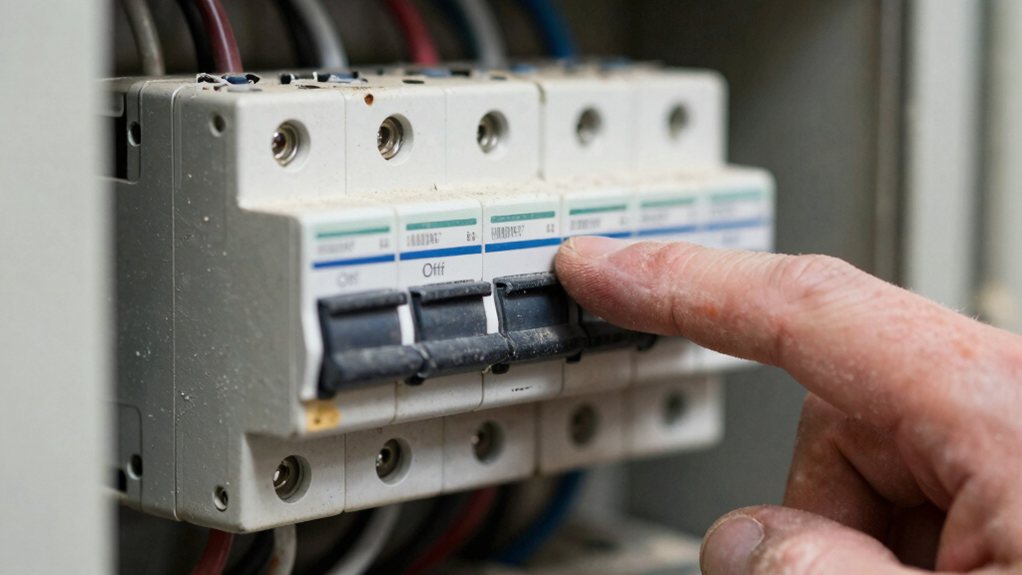
Just flip it back? Learn why your breaker keeps tripping and the hidden dangers you need to know before you reset it again.
To safely reset a tripped breaker, first grab a flashlight, locate your panel, and push the tripped breaker fully to OFF and then to ON. If it trips again immediately, don’t force it, as the cause is likely an overloaded circuit, a short, or a faulty device, which can be a fire risk. Unplugging items before resetting often helps, but persistent trips signal a deeper issue requiring an electrician—more details are coming up next.
Table of Contents
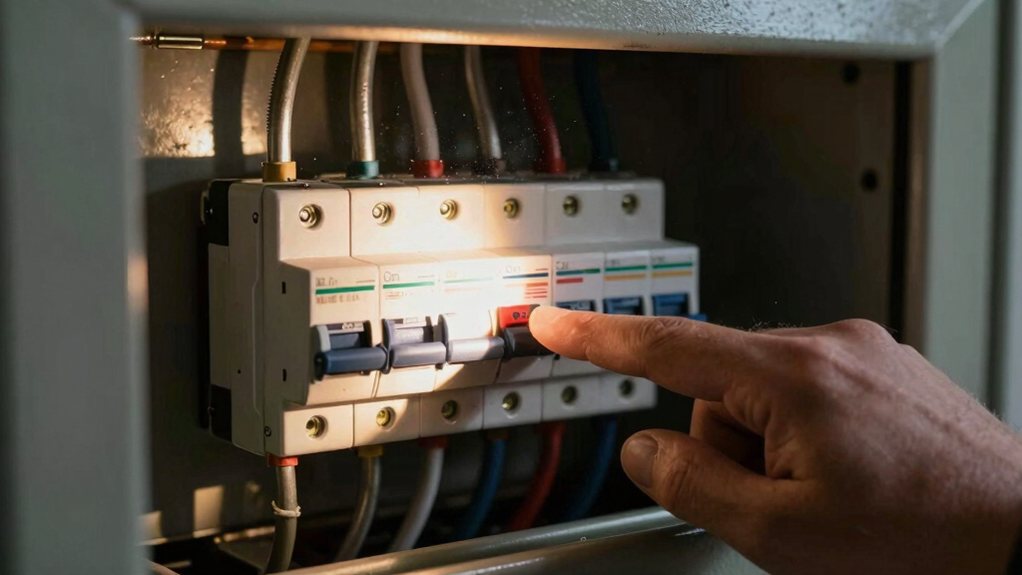
Before you can reset a circuit breaker, it helps to know what it’s and why it got tripped in the first place.
A circuit breaker is like a watchful guard for your home’s electrical wiring, automatically shutting off power if things get dangerous.
It typically trips for three main reasons.
An overload happens when you plug in too many devices, like running a space heater and microwave on the same circuit.
A short circuit is more serious, caused by a hot wire touching a neutral one, often with sparks.
A ground fault occurs when electricity escapes to a grounded surface, like water or a metal box.
Knowing which fault you’re facing helps you safely reset the system or call for help.
Modern homes often upgrade to smart home electrical panels for improved safety and control.
First, grab a flashlight and find your electrical panel to spot the tripped breaker, which will be the one with its handle in a different position than the others.
Next, turn off and unplug everything on that circuit, then firmly push that breaker to OFF and back to ON until it clicks into place.
After that, plug your devices back in one at a time, waiting a few minutes between each, so you can figure out if one of them is causing the problem.
Also, consider the circuit amperage and total load on the breaker to avoid repeated trips.
So, how do you figure out which breaker decided to take an unscheduled break? First, locate your panel—often in the basement, garage, or a hallway closet. Grab a flashlight to see clearly.
Now, scan for the tripped circuit breaker. Its handle will be in a middle position, feel loose, or clearly show “OFF,” unlike its firmly “ON” neighbors. That’s your culprit among the other breakers.
Before resetting a tripped one, an essential safety step is to Unplug all appliances on that dead circuit. This removes the overload that likely caused the circuit breaker tripped event.
Identifying the right switch is your key to solving the puzzle safely and getting your power back on track.
Now that you’ve spotted the tripped breaker, you’re ready for the main event—actually getting that switch back to work, which is a simple process if you follow a few key safety steps.
First, stand on a dry surface.
Firmly push the handle fully to the OFF position; you’ll likely feel some springy resistance.
Then, without hesitation, flip it all the way back to ON until it clicks into place.
This action resets the tripped circuit.
If it holds, fantastic! Your overloaded circuit is now clear.
However, if it trips again immediately, your breaker panel is telling you something’s wrong.
Don’t try to reset a tripped circuit repeatedly.
Just leave it off and call a licensed electrician to investigate the real issue.
Before you reset that breaker again, you can figure out why it tripped by checking for a few common culprits.
Look for signs of an overloaded circuit, like too many gadgets running at once, or more serious issues like short circuits and ground faults.
Don’t forget that a single overheating appliance or a worn-out breaker itself could also be the sneaky source of your trouble.
If you’ve ever reset a breaker only to have it pop again moments later, there’s a good chance an overheating appliance is the troublemaker.
These issues often sneak up on you, and they’re usually due to one of these common problems:
Basically, when an appliance gets too hot trying to do its job, it pulls more power than the breaker allows, and click—you’re back in the dark.
Sometimes your tripping breaker is just a simple sign that you’re asking too much of a single circuit, like when your toaster, microwave, and coffee maker all decide to party at the same time on the same outlet.
This is a classic circuit overload.
Your breaker keeps tripping because you’re drawing too much power—more than its safe 15-20 amp capacity.
You’ll notice it happens when multiple appliances run together, or when a single big one like a space heater kicks on.
Lights might dim or flicker, too.
It’s the breaker’s way of shouting, “Hey, cool it!”
The fix is simple: unplug a few things and spread your power-hungry gadgets across different overloaded circuits.
Now, let’s look at what’s happening when a breaker trips and it isn’t just too many gadgets plugged in.
You’re likely dealing with a more serious wiring issue, like a short circuit or ground fault.
These problems need your attention for safety.
Here’s a quick guide to help you understand the common culprits:
To confirm it’s due to an overload, check which devices are on when it trips.
High-wattage items like space heaters are common culprits.
The fix? Unplug something or move an appliance to another outlet on a different circuit.
If trips keep happening, it’s a clear sign to hire a professional electrician.
They can install a dedicated circuit, solving the problem for good.
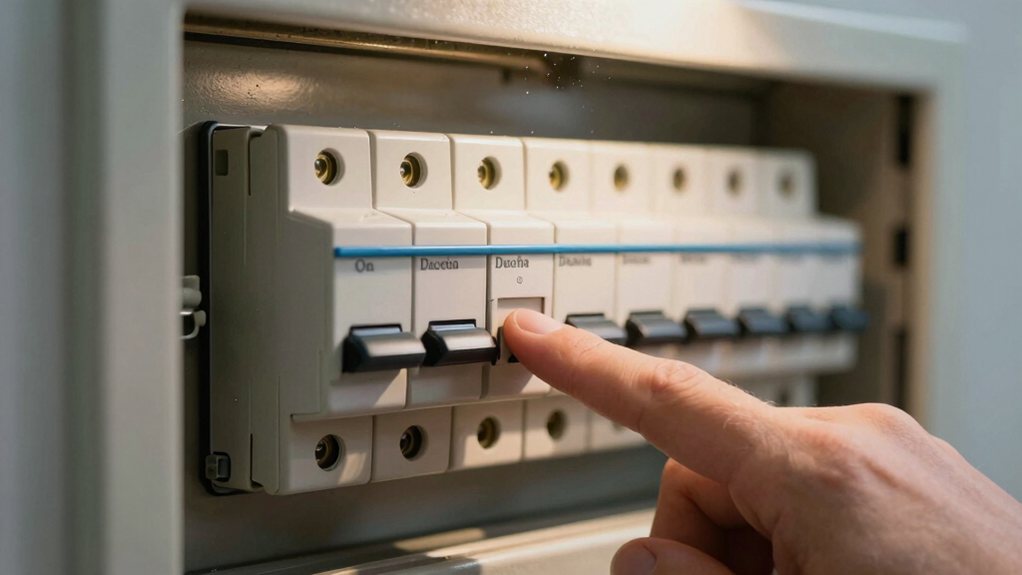
You’ve learned how to spot an overloaded circuit, but what if your breaker trips with a pop and a puff of smoke, or just won’t stay on at all?
That’s likely a short circuit or ground fault—more serious wiring faults needing immediate attention.
When a breaker trips with a pop or won’t reset, it’s a serious short circuit or ground fault requiring an electrician.
Here’s how to tell the difference:
You can also use a thermal imaging camera to spot hot spots in wiring before they cause failures.
Ever wondered if your grumpy circuit breaker is the real problem, or if it’s just faithfully reporting trouble from elsewhere?
Sometimes, the breaker or panel itself is faulty. Aging circuit breakers can have worn parts that cause nuisance trips.
If your breaker continues to trip after you’ve unplugged everything, feels hot, or makes buzzing noises, it’s likely the culprit. These are serious signs; a breaker that won’t stay on or has scorch marks is begging for a professional electrician.
Don’t keep resetting a faulty breaker. Repeated tripping wears it out, and a worn breaker mightn’t stop a dangerous fault, a leading cause of electrical fires. When in doubt, call a pro for safety’s sake.
If your breaker’s been acting up, you might think hitting the reset switch a few times is no big deal, but that’s actually how a small electrical annoyance can turn into a very real fire hazard.
Each attempt to reset the breaker against a problem forces it to work through trouble, creating sparks and heat.
This isn’t just about the inconvenience of circuit breaker tripping; it’s about safety.
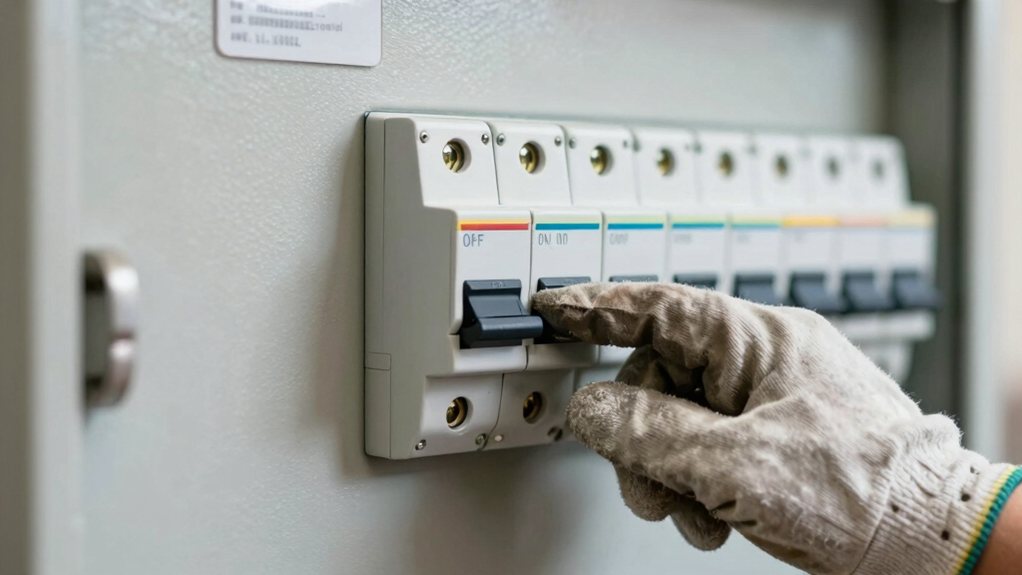
When your circuit breaker trips and stays that way, it’s sending a clear message, so your best move is to listen carefully while you wait for professional help.
First, don’t just flip it back on repeatedly; trying to restore power that way can cause a breaker to arc and start a fire.
Never repeatedly flip a tripped breaker; forcing power back on can cause arcing and start a fire.
Leave it off.
Your immediate job is safety: unplug everything on that tripped circuit and keep everyone away from any sparking outlets—a ground fault is no joke.
If you need lights, plug a single lamp into a different, working circuit.
Finally, play detective for your electrician. Note which appliances were running or if you smelled burning. This clues them in on why your circuit breaker keeps failing, so they can fix it fast and safely.
Consider installing luxury outlet covers to match your décor while an electrician evaluates the issue.
A compatible smart home automation hub can integrate sensor data to centralize alerts for quicker action.
So, you’ve got a handle on those pesky breakers now. Remember, they’re just looking out for you, so don’t ignore their warnings. If a breaker keeps tripping, it’s telling you something’s wrong. Please don’t just fight with it—call a pro. Staying safe is the whole point, after all. A little caution now can save you a major headache, or worse, later. Here’s to fewer surprises and more peace of mind.