Phone:
(701)814-6992
Physical address:
6296 Donnelly Plaza
Ratkeville, Bahamas.

Phone:
(701)814-6992
Physical address:
6296 Donnelly Plaza
Ratkeville, Bahamas.
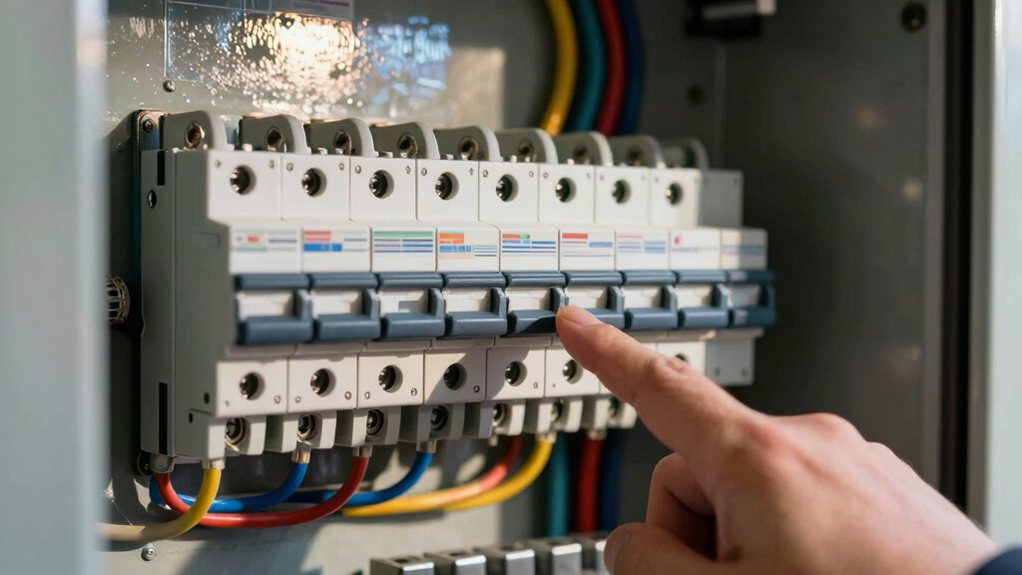
Learn your electrical panel's basics, spot issues, and handle minor problems—but discover the crucial tip you're missing inside.
Your electrical panel is your home’s command center, sending power safely to all your lights and appliances. You’ll find this metal box in places like your basement or garage. Inside, the main breaker controls everything, while smaller circuit breakers protect individual circuits. If a breaker trips, safely reset it by switching it fully off and on. Getting familiar with your panel helps you handle minor issues and spot real trouble—there’s more helpful info just ahead.
Table of Contents
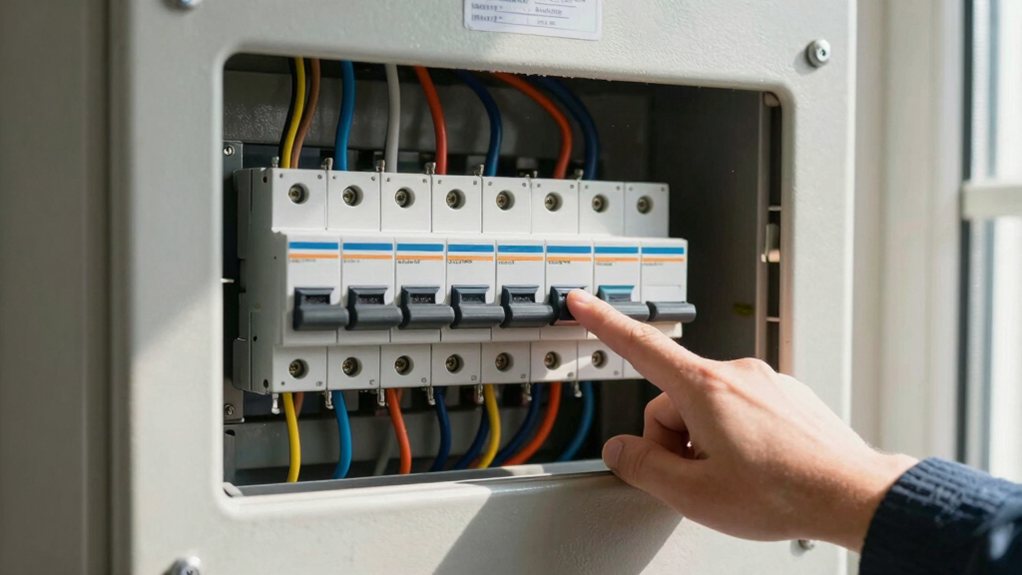
Think of your electrical panel as the heart of your home’s electrical system, quietly pumping power to every light, outlet, and appliance. It all starts at the main breaker, which brings the utility’s electricity into your home.
Inside the panel, this power flows to bus bars that feed individual circuit breakers. Each breaker controls a specific circuit, like your kitchen outlets or bedroom lights, and acts as a safety guard—it trips if there’s an overload.
Properly labeled breakers let you quickly cut power for repairs, which is a huge win for safety. Understanding this hub helps you prevent problems and guarantees electricity flows reliably where you need it, keeping your daily life humming along seamlessly. Many homeowners are upgrading to smart electrical panels for added monitoring and control.
Ever wondered where your home’s electrical lifeline is hiding? Your electrical panel, that gray metal box with the main breaker, is often in predictable spots.
Check your basement, garage, or a utility room first. In apartments or smaller homes, peek inside hallway closets or the kitchen pantry.
Follow the thick service cable from your outdoor electric meter; the panel is usually mounted nearby on the same wall. Don’t forget to check for a subpanel in an addition, workshop, or outbuilding.
Once you find it, spend a few minutes labeling each circuit clearly—this simple act is a huge help during a tripped-breaker emergency or when you need to quickly shut off power.
Now that you’ve found your electrical panel, you’re ready to understand what all those switches and labels mean.
Start by checking the panel door labeling; each switch should have a clear circuit breaker labels like “Kitchen.” If not, you’ll need to identify circuits by testing.
Notice the breaker positions: “On” faces the panel’s center, while “Off” points out.
A reset tripped breaker sits in the middle, so push it fully to Off, then back to On.
Read the amperage ratings (like 15A or 20A) to match your gadgets’ needs.
Spot special GFCI/AFCI breakers by their Test buttons and double‑pole breakers (two switches tied) for large appliances.
Finally, know your main breaker for an emergency shut-off, giving you total control.
Also, if you’re planning lighting or control upgrades, confirm whether the devices you intend to install are neutral required before you begin.
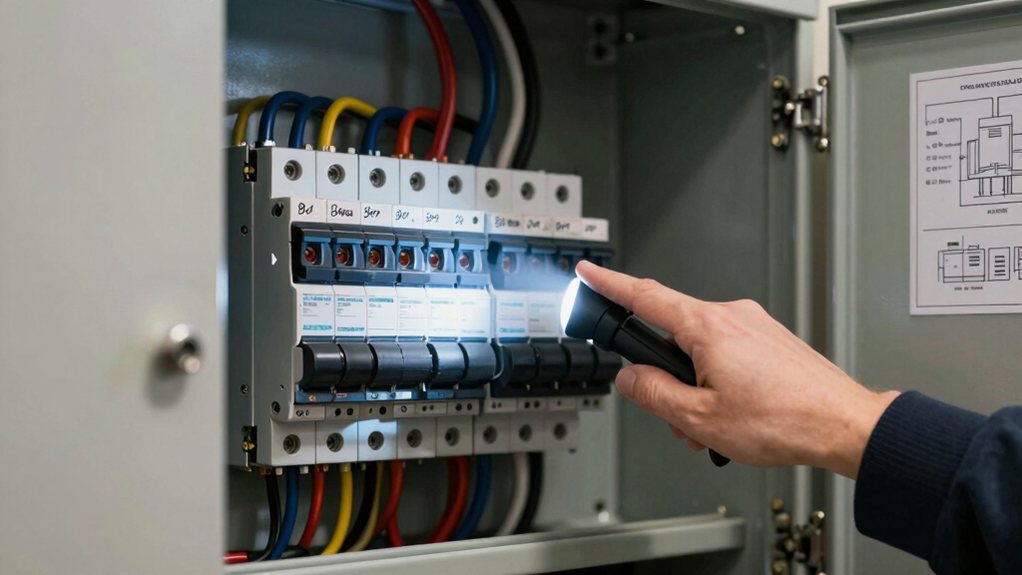
Let’s take a look at the main players inside your electrical panel, starting with the big boss, the main breaker.
You’ll also see a collection of individual circuit breakers, which come in different types and sizes to protect your home’s various circuits.
Understanding these parts is like knowing the key members of your home’s electrical team, and it’s simpler than you might think.
Have you ever wondered how all the electricity coming into your home can be turned off with a single switch? That’s the job of your main breaker, the largest switch in your breaker box.
Think of it as the master gatekeeper for your electrical panel. It connects the incoming service conductors to the panel’s bus bars, which then feed all your smaller circuits.
Its ampere rating, found on the panel label, tells you your home’s total power capacity. As a whole‑home disconnect, flipping it off safely isolates everything.
It also provides vital overcurrent protection. If it trips/reset, every circuit goes dark, signaling a serious issue that needs fixing before you reset it—no guessing allowed!
While your main breaker acts as the big boss of your electrical panel, the real workhorses are the rows of smaller switches—the circuit breakers—that protect each individual circuit in your home.
They’re the first line of defense against circuit overloads and trips. You’ll see a few common types in your panel:
Consider coordinating your panel’s appearance with luxury outlet covers to keep both form and function in elegant homes.
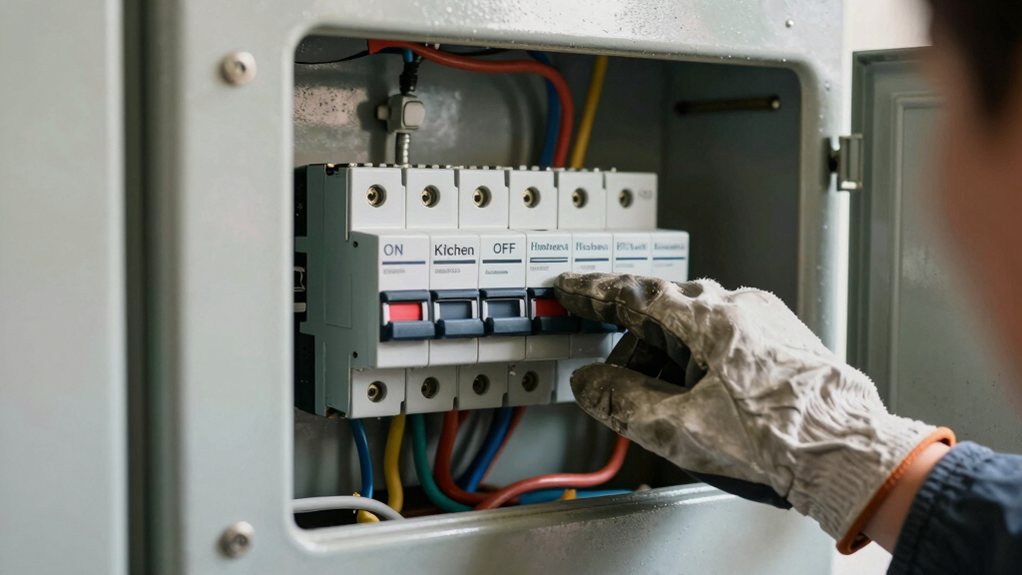
So, you’ve found the culprit breaker—it’s the one that feels a bit loose or is sitting in a middle position.
Before you flip it, take a quick second to unplug the hair dryer or space heater that likely caused the overload, because it’s much easier to reset a breaker than a frazzled mood.
Then, with dry hands on a dry floor, firmly switch that breaker to “Off” and back to “On.”
If it pops right back off, it’s time to call a pro instead of wrestling with it.
If you’ve ever heard a quiet “click” from your electrical panel and suddenly your kitchen lights go dark, you’re likely dealing with a tripped breaker, which is your home’s built-in safety system saying, “Hey, let’s take a break!”
Spotting the culprit is usually straightforward: look for the breaker switch that’s sitting awkwardly between ON and OFF, feeling a bit warmer than its neighbors, or simply not aligned with the rest.
Before you reset the breaker, a quick safety check is key.
Consider using a thermal imaging camera to spot hidden hot spots in your panel safely.
Now that you’ve safely checked things out, it’s time to give that breaker a proper reset—think of it as a gentle reboot for your home’s electrical system.
For added protection, consider wearing items from a professional safety equipment kit when inspecting your panel.
First, confirm the appliance or light fixture causing the issue is unplugged or switched off.
Find your tripped breaker in the panel; it’ll feel loose between On and Off.
To reset the appropriate switch, firmly push it all the way to Off, then back to On.
If it immediately trips again, don’t force it—that’s a sign to call a professional.
Always watch for signs like hissing sounds, frequent tripping or flickering, or any burning smell, which mean it’s time to shut off the power at the main breaker and get expert help.
When your breaker keeps tripping, it’s like your electrical panel is raising a red flag to get your attention, and you’ll want to handle this situation carefully.
Don’t just keep forcing it; that’s a one-way ticket to trouble.
Instead, follow a smart, step-by-step approach.
1. Unplug and Reset: First, unplug all devices on that circuit.
Then, firmly reset the breaker by switching it fully Off and back On.
If it holds, plug things back in one at a time to find a faulty appliance causing the trip.
2. Check for Serious Signs: Never operate a breaker that feels hot, buzzes, or shows burn marks.
Turn it Off and call a licensed electrician immediately—safety first!
3. Know When to Call a Pro: If it trips more than a few times, especially with double-pole (240 V) breakers for large appliances, or with minimal load, you likely have overloaded circuits or a wiring fault.
It’s time for a professional inspection.
To keep your electrical panel safe, you should always handle it with care by keeping the area clear and never touching exposed wires.
It’s smart to know when to call a professional, like when you spot warning signs or if your panel is older and struggling.
Consider integrating a smart home hub to centralize device control and enhance safety.
Because your electrical panel is the heart of your home’s power, treating it with respect is key to keeping your family safe.
Think of safe handling like a simple recipe: follow the steps, and you’ll avoid a shocking experience.
Your main goal is to never get a surprise from live wires.
1. Always Power Down & Verify: Before any work, switch off the main breaker.
Then, double-check wires are dead using a non-contact voltage tester—it’s your best friend for safety.
2. Respect the Panel’s Boundaries: Never remove the panel cover; that’s a job for a licensed electrician.
Keep a clear 30 inches of working space around it and stand on a dry insulated surface.
3. Use Your Senses & Gear: Wear insulated gloves and safety glasses (your PPE).
If a breaker won’t reset or you hear buzzing/arcing or burning smell, shut the main power and call your electrician immediately.
While your electrical panel is a bit like a trusty old friend, it’s one that sometimes needs a professional’s touch to keep your home humming along safely.
Always call a licensed electrician if you have repeated breaker trips, smell burning, or a breaker won’t reset.
Never remove the panel cover yourself; that’s strictly a job for a pro with the right gear.
Stick to a regular inspection schedule, and discuss panel replacement if yours is decades old.
Ask your electrician to perform GFCI/AFCI testing and check grounding continuity for safety.
Also, request a 200-amp upgrade assessment before adding high-demand loads like an EV charger.
Finally, have them label circuits clearly—it’s a small task that saves huge headaches later.
Consider integrating a smart home automation system for coordinated control of lighting and energy loads.
Around your home, your electrical panel is like the quiet, hardworking brain of your entire system. Sometimes it sends up clear signals that it’s in trouble.
Knowing these signs can prevent a small issue from becoming a major problem, like a potential fire. Pay close attention to these three key warnings:
Now that you’re aware of what to watch out for, let’s look at the breakers inside your electrical panel.
You’ll mainly see two types. Single-pole breakers occupy one slot and protect your standard 120 V circuits, like lights and outlets, with a typical amperage rating of 15 or 20 amps.
Double-pole breakers are wider, using two slots to power large 240 V appliances, such as dryers or ranges. They’ve a higher amperage rating and an important common trip feature, so both sides shut off together for safety. This is also essential for a multi-wire branch circuit, which shares a neutral and requires a handle-tie.
Always check your breaker panel’s circuit labeling to know what each one controls. Consider integrating a smart home hub to centralize control of connected devices.
1. Call immediately for danger signs:
This includes a warm panel, buzzing sounds, or burning smells, as these can signal an imminent electrical emergency or fire.
2. Call for persistent power problems:
If breakers frequently trip or restoring power requires constant resets, a pro can diagnose the fault.
3. Call before major projects:
Always call a professional to install a new appliance like an EV charger or to upgrade your service. They handle the complex bars that distribute electricity safely.
Consider integrating a smart home lighting system for convenience and energy savings.
Now you’ve got a solid handle on your electrical panel, which is pretty empowering stuff. Remember, safety always comes first, so don’t hesitate to call a pro if something seems off. With this knowledge, you can tackle simple tasks confidently and make smart decisions for your home. Here’s to keeping the lights on and your peace of mind intact!